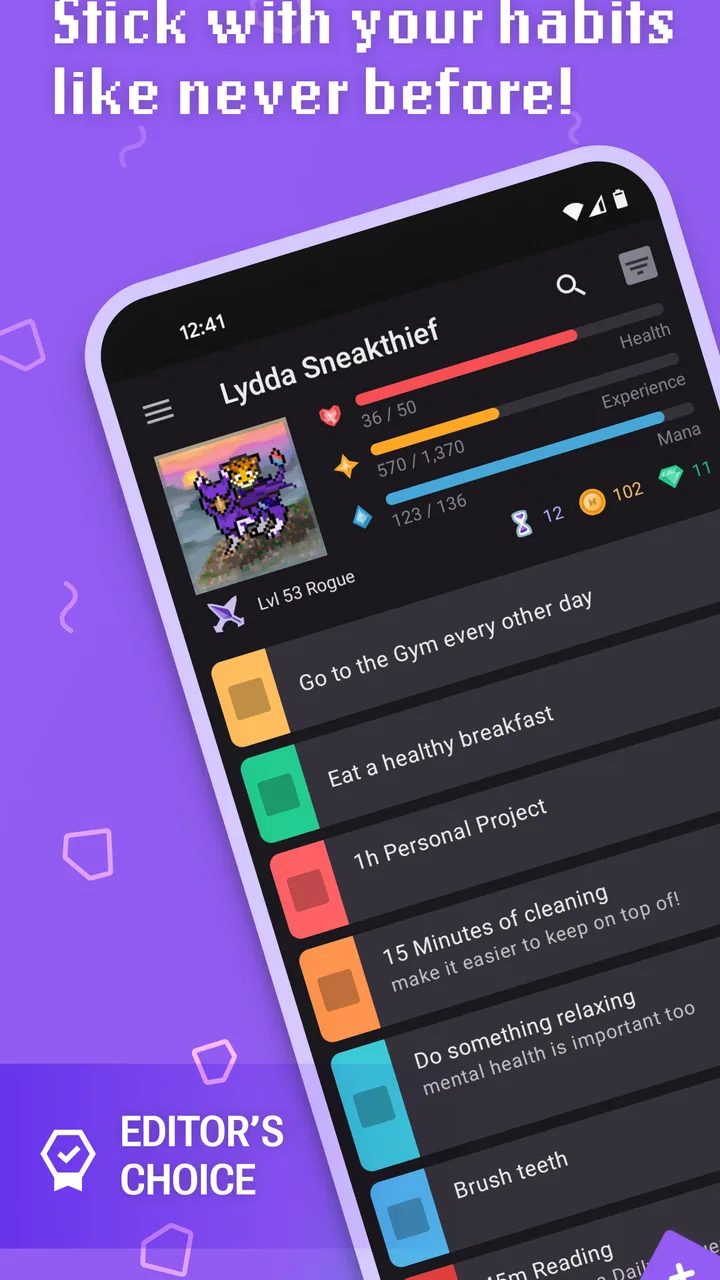
Habitica: Gamify Your Tasks
- 4.7
- Rating
- 5.00M
- Installs
- Free
- Price

 Analysis by App-foxy
I approached Habitica as a productivity app first and a game second, and that distinction matters. Its central idea is simple: turn everyday tasks, habits, and routines into actions connected to a role-playing-game-style character. Instead of staring at a plain checklist, I get a small sense of progress from completing what I already intended to do. That extra layer can make ordinary chores feel more visible and rewarding, although it is not equally helpful for every kind of user.
Developed by HabitRPG, Inc., this free productivity app is aimed at people who want motivation as much as organization. It is available to an Everyone audience, and its current version is 4.10.4 for devices running Android 8.0 or later. The app has reached over five million installs, with a 4.7 average from around seventy-five thousand ratings, so it is clearly more than a niche experiment. After spending time with its task-based approach, I found that its strongest quality is not the fantasy theme by itself, but the way it makes repeated behavior easier to notice and maintain.
How the free model affects the experience
The important starting point is that Habitica can be used without paying. That makes it easy to test the complete idea before deciding whether optional spending is worthwhile. The app includes in-app purchases ranging from $0.99 to $47.99 per item, but the existence of those purchases does not change the basic value question: if you only want a game-like task manager, you can begin at no cost and judge whether the system actually improves your routine.
You May Also Like

 Blood Strike: 2.5 Anniversary
Blood Strike’s Loadouts Turn Every Drop Into a Tactical Gamble
A close look at Blood Strike’s custom loadouts: how fast access to signature weapons reshapes its battle royale rhythm, rewards preparation, and narrows the gap between fights.

 Pandora - Music & Podcasts
Pandora’s Music Is Easy to Start, but Harder to Recover
Pandora’s strength is its low-effort path from a seed to a station. Its weak spot is how much confidence it asks you to place in connection, setup, and quiet recovery.

 8 Ball Pool
 Is Built on Rivalries, Rematches, and Routine
A close look at the rivalries, rematches, shared routines, and unanswered safety questions that turn a quick pool match into a persistent mobile community.

 Samsung Music
’s Quiet Strength Is Playing What You Already Own
Its reach comes less from spectacle than from dependable access to a personal library. That simplicity is both the app’s strongest retention engine and its ceiling.

 AccuWeather: Weather Radar
AccuWeather Review: A Quick, Clear Forecast for Everyday Decisions
For everyday plans, the best forecast is the one you can understand quickly. AccuWeather makes rain timing, radar, and local conditions easy to act on, with a few trade-offs.

 Hill Climb Racing
Why Hill Climb Racing Still Turns Crashes Into One More Run
A tiny car, a bumpy hill and one more upgrade: Hill Climb Racing keeps resurfacing because its simple chaos makes every near-miss feel personal.
More From Our News Desk
View All News


I appreciate that arrangement because this type of productivity method is personal. Some people respond immediately to character progression and virtual rewards; others find the game layer distracting after a few days. Paying before discovering which group you belong to would make little sense. With Habitica, I can create a few tasks, use the routine for a while, and decide based on my own consistency rather than on the promise of a conventional premium planner.
The paid side should be viewed as optional value, not as a requirement for understanding the app. Since individual purchases can differ in purpose and appeal, I would not treat the highest listed item price as a recommendation or assume that buying something will solve weak habits. The most valuable part of the experience is the structure: deciding what matters, recording it clearly, and returning often enough to learn from the pattern. If that structure does not suit me, extra spending would not fix the mismatch.
What I actually get from the basic setup
Habitica gives me a place to separate one-off responsibilities from recurring behaviors and longer projects. That separation is more useful than it first appears. A task such as submitting a form should not be treated the same way as a behavior such as drinking enough water, while a larger objective may need several smaller actions before it feels complete. Keeping those ideas distinct helps me avoid the common mistake of putting an entire week into one overwhelming checklist.
The game framing also creates a consequence for ignoring certain entries. That can be motivating when I have chosen realistic commitments, because completing them feels like progress and neglect becomes visible. It can be counterproductive when I create too many ambitious goals. In that situation, the app may turn into a daily reminder of unfinished intentions instead of a helpful guide. My first practical recommendation is therefore to begin with only the routines I genuinely want to protect, not every improvement I can imagine.
The best value comes from the feedback loop, not from collecting digital extras. I use the app more effectively when I treat the character and rewards as prompts to act rather than as the destination. The fantasy presentation is a wrapper around planning, repetition, and review. If I focus only on the reward mechanics, I can end up optimizing the checklist instead of improving my day.
Where the game layer helps in real life
A realistic use case is a busy weekday when I have a few fixed responsibilities, several small household jobs, and one habit I keep postponing. In a normal notes app, those items can blend into a long list. In Habitica, I can give the fixed responsibilities their own tasks, keep the repeated behavior separate, and use the daily rhythm as a reason to return. Checking off a small action such as preparing something the night before can feel more meaningful when it contributes to a larger personal routine.
This is especially useful for people who understand what they should do but struggle to begin. The app does not remove the work, yet it lowers the psychological distance between intention and action. A plain reminder says, “remember this.” Habitica asks me to make the action part of an ongoing system. That difference is modest, but for repetitive chores or study sessions, modest friction is often the problem.
I also found the approach helpful for breaking vague goals into observable actions. “Get organized” is too broad to complete honestly. “Sort the papers on the desk” is specific enough to finish. Once a large ambition is translated into smaller entries, the app becomes less like a motivational toy and more like a practical planning tool. This is one of its less obvious strengths: the game encourages me to define what completion actually means.
Using routines without turning them into punishment
Habitica works best when I review my list regularly and adjust it. A routine that was sensible last month may be wrong during a busy week. I would rather edit an unrealistic daily commitment than repeatedly mark it as missed and become discouraged. The app rewards honesty in setup. If I use it to judge myself harshly, the system becomes noisy; if I use it to observe patterns, it becomes informative.
One useful workflow is to create a small “minimum version” of a habit. Instead of demanding a long workout, I might define a short, clearly achievable action as the baseline and add a separate task for more effort when appropriate. This keeps the routine alive on difficult days without pretending that every day has the same energy. Habitica’s game-like progression makes that distinction visible, but the judgment still has to come from me.
Another practical tip is to avoid adding rewards that are too easy to claim or too disconnected from real priorities. The reward system is more meaningful when it supports something I already value, such as a proper break after focused work. If every item produces the same emotional response, the novelty fades. I get more from the app when I periodically ask whether my chosen incentives are helping me start tasks or merely encouraging me to tap through the list.
How it compares with ordinary productivity tools
Compared with a standard checklist app, Habitica offers more emotional feedback and a stronger reason to return. A conventional list is often cleaner and faster for capturing errands, especially when I need to write something down immediately. Habitica takes more thought because tasks belong to a broader behavior system. That extra structure is worthwhile for users who need accountability, but it may feel excessive for someone who only wants a quick place to store reminders.
Compared with calendar-centered planning, Habitica is better suited to repeated personal actions than to appointments and time-specific schedules. A calendar tells me when something happens; Habitica is more interested in whether I keep showing up for the behavior. I would not replace a calendar with it for a day packed with meetings. I would use it alongside one when the real challenge is maintaining routines between those fixed events.
Compared with minimalist habit trackers, Habitica is more playful and potentially more engaging, but also less neutral. A minimalist tool can disappear into the background, which is useful when I want quiet consistency. Habitica deliberately asks me to interact with its theme and progress system. That is an advantage for people who enjoy visible momentum and a disadvantage for anyone who finds role-playing elements childish, distracting, or emotionally tiring.
Its approach also differs from a traditional project-management app. Habitica can help me turn a project into personal actions, but it is not the place I would expect detailed team planning, complex dependencies, or professional workflow control. Its value is strongest at the individual level, where motivation and repetition matter more than formal coordination.
Trade-offs I noticed after using the system
The biggest limitation is setup discipline. The app can only motivate the tasks I define, and defining them badly creates a poor experience. If I enter broad goals, duplicate routines, or too many daily obligations, the interface reflects that confusion. The game layer may make the clutter more noticeable, but it cannot decide which commitments deserve my attention.
There is also a risk of becoming more interested in maintaining the character than in completing meaningful work. That does not happen to everyone, but it is a genuine trade-off. Some users will enjoy the extra sense of progression; others may feel that ordinary responsibilities have been turned into a performance. I would skip this style if I already dislike points, streaks, avatars, or reward loops in productivity software.
Another friction point is that missed tasks can feel heavier than missed reminders in a neutral app. For me, that is useful only when the task was realistic and important. If circumstances change, I need to edit the plan rather than blindly preserve it. The app encourages consistency, but consistency should not mean refusing to adapt. A flexible routine is more sustainable than a perfect-looking list that creates guilt.
The free access is a real advantage, but it does not guarantee that the method will fit every workflow. People who need fast capture, detailed scheduling, or a visually restrained interface may get more value from a simpler alternative. People who need shared professional planning may also be better served by a tool designed around projects and collaboration rather than personal gamification.
Questions I would settle before committing
If I am wondering whether I need to pay, my answer is to start free and use the core routine long enough to see whether I return voluntarily. Optional purchases may appeal to users who want additional value from the themed experience, but I would not buy anything merely because I am struggling with consistency. First prove that the basic workflow changes what you do.
If I am worried about age suitability, the Everyone rating makes the app broadly accessible from a content standpoint. That does not mean every child or adult will enjoy the motivational design. Younger users may like the game framing, while some adults may prefer a quieter interface. The better question is whether the person using it responds well to visible progress and self-managed goals.
If I am unsure how many tasks to add, I would begin with a few actions that happen often enough to reveal a pattern. Add complexity only after the routine feels manageable. This is more important than filling every section immediately. Habitica becomes clearer when each entry has a purpose, a sensible frequency, and a definition of success that can be understood at a glance.
If I am choosing between this and a regular planner, I would ask what usually stops me. If the problem is forgetting appointments, use a calendar. If the problem is starting repetitive personal tasks, Habitica is more promising. If the problem is managing a large shared project, choose a dedicated project tool. The app is not a universal replacement; it is a focused answer to the motivation gap inside personal productivity.
Who is most likely to get lasting value
I would recommend Habitica to students, remote workers, busy households, and anyone trying to establish routines without relying entirely on willpower. It is particularly suitable for people who enjoy light game mechanics and want their daily actions to feel connected to a longer progression. It can also help users who have tried plain lists repeatedly but abandon them because checking boxes feels too mechanical.
It may be useful for someone returning to structure after a chaotic period. Starting with a small set of repeatable actions can create a sense of control without demanding a complete life overhaul. The important word is small. The app rewards a sustainable rhythm more effectively than an ambitious setup that collapses after a few days.
I would not recommend it first to someone who wants a silent, instant note-taking tool, a sophisticated calendar, or a professional team workspace. I would also be cautious if gamification tends to create anxiety or if missed goals already produce excessive self-criticism. In those cases, a calmer habit tracker or a plain checklist may be the healthier and more efficient choice.
For me, the deciding strength is that Habitica makes behavior visible. It gives ordinary actions a little narrative weight without requiring me to pretend they are exciting. The deciding weakness is that the same narrative can become pressure when the plan is unrealistic. That balance explains why the app feels excellent for some routines and awkward for others.
After testing its approach, I see it as a worthwhile free experiment rather than an automatic replacement for every productivity app. The cost barrier is low, the concept is distinctive, and the system can make repeated actions easier to start. Its optional purchases should be considered only after the free experience has demonstrated real usefulness for me.
My verdict is to try it if motivation is your main obstacle, and skip it if simplicity or scheduling precision matters more than engagement. Habitica delivers its best value when I keep the task list honest, use the game elements as encouragement, and review the routine instead of obeying it blindly. With that mindset, it becomes a friendly companion for building habits; without it, the fantasy layer can become one more system to manage.
FAQs for Habitica: Gamify Your Tasks
01What is Habitica: Gamify Your Tasks, and how does it work?
Habitica is a productivity and habit-building app that turns everyday responsibilities into a role-playing game. You create a character, add habits, daily tasks, and to-dos, then earn experience and rewards for completing them. Your character can level up, collect equipment, and unlock features, making routine organization feel more interactive and motivating than a traditional checklist.
02Is Habitica suitable for managing habits, daily routines, and one-time tasks?
Yes. Habitica separates tasks into habits, dailies, and to-dos, so it can support several types of planning. Habits are repeated behaviors that can be marked positively or negatively, dailies are scheduled activities, and to-dos are individual assignments. This structure is useful for studying, fitness, household chores, work projects, and personal routines, although it requires consistent setup.
03Can I use Habitica with friends or join groups?
Habitica includes social features that allow users to connect with friends, form parties, join guilds, and participate in challenges. Party members can work toward shared goals and, in some cases, support one another through game mechanics. These options can add accountability and motivation, but the experience depends on finding active, respectful participants whose schedules and objectives match your own.
04Is Habitica free to download, and are there optional purchases?
Habitica can generally be downloaded and used without paying for the basic productivity and role-playing features. Depending on the platform and current offering, the app may provide optional subscriptions, in-app purchases, or supporter benefits that unlock cosmetic items and additional conveniences. Users should review the current store listing before downloading because pricing and available features can change.
05Does Habitica require an internet connection, and is my progress synchronized?
Habitica is designed to synchronize your tasks, character information, and progress across supported devices when you sign in to an account and have an internet connection. Some basic interaction may be possible temporarily while offline, but synchronization and social features require connectivity. To avoid losing changes, allow the app to finish syncing before switching devices or reinstalling it.
Pros
- Turns daily tasks into motivating RPG-style goals.
- Flexible habits
- dailies
- and to-do lists suit different routines.
- Parties and challenges add useful social accountability.
- Strong customization through rewards
- equipment
- and avatars.
- Available on Android and iOS with progress synced across devices.
Cons
- The game mechanics may feel distracting for users wanting a simple planner.
- Some useful content and cosmetic items require in-app purchases.
- Missing tasks can reduce health
- which may feel discouraging.
- The interface takes time to understand
- especially for new users.
- Social features depend on finding an active and compatible party.

Habitica: Gamify Your Tasks
Gallery